Sunday, 8 June 2014

Spider Disguises Itself as Bird Droppings

It’s the ultimate crappy disguise: The spider Cyclosa ginnaga hides from predators by looking like a pile of bird feces, a new study says.

Study leader I.-Min Tso, an entomologist at National Chung Hsing University in Taiwan, first made the discovery walking through a research station in central Taiwan.
Spider Disguises Itself as Bird Droppings
Tso noticed Jackson Pollack-style splotches of white bird dung, which stood out in stark contrast to the lush green foliage. But when he looked more closely, Tso realized that not all of the blobs were bird droppings: A few were spiders in their webs. (Read about a spider that weaves a mysterious picket fence.)

Tso recognized the spiders as C. ginnaga, a species found in Taiwan, China, Japan, and South Korea.

As the “architects of the spider world,” spiders in the genus Cyclosa are known to create elaborate webs, using their silk to make concentric circles like Saturn’s rings and adding debris such as twigs and leaves that hide young spiders from predators. (Related: “New Spider Weaves Spider-Shaped Web.”)

Now, Tso and colleagues have discovered their defense strategy is even more sophisticated than thought.

Cornell University arachnologist Linda Rayor applauded the study, pointing out that C. ginnaga is not alone in masquerading as bird droppings.

“It’s really not all that uncommon. Several other spiders, like Bolas spiders, also use this disguise,” she said.

Web of Disguises

To find out if the bird dropping-like web confused predators, Tso and colleagues measured the webs that resembled bird feces.

Source: Here

Saturday, 7 June 2014

Strange Gender-Bender Bird

There are a lot of unusual things in the animal world which we don’t really notice, especially if they’re really not that obvious. However, some things are just too strange to miss out.

A gynandromorph is any animal that contains both male and female characteristics. A very common example would be with birds. Amongst cardinals (Cardinalis cardinalis), the ones with gynandromorphy would have half bright red and half light gray or brown bodies.  Normally, a male cardinal has bright red feathers that make them stand out from the females.

Gynandromorphy is a very rare case. You’d be really lucky to spot one of these birds. Larry Ammann, a University of Texas statistics professor, was very fortunate to take pictures of this specimen in his own backyard. He took a few photos of the bird but it flew away right after.

Basically, there was a genetic mishap that happened during the cell division in the fertilized ovum, resulting to one side to have male characteristics and the other female. As the bird developed in the egg, each of the sides continued to develop as male and female. Since cardinals have very striking difference between male and female specimens, gynandromorphy is very obvious amongst them.


Another thing that Ammann noticed about the bird is that it doesn’t sing or make sounds like the other cardinals. He’d hear the other birds chirping but the gynandromorph won’t make a sound. He also noticed that the other male cardinals would chase it away from their territory while the females don’t seem to be concerned by it. 

Friday, 6 June 2014

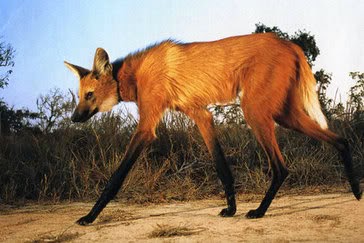
Long Legged Wolf of South America

There are a lot of strange looking animals in South America, most of which many of us don’t even know existed. Imagine seeing an animal that looks like a fox, but has long legs like a gazelle.


This creature, called the maned wolf, definitely stands out from other fox or dog like animals. They stand at around 3 feet tall and weigh in at 50 pounds. It’s the biggest canid you can find in South America and it resembles a fox with reddish- brown fur and long legs. From its name, it has a mane found along their backs. Their ears are long and large, growing to about 7 inches. They also have distinct white markings on the tips of their tails and throats and their legs are usually dark in color.

These wolves are usually seen in southeastern and central Brazil, northern Argentina, eastern Bolivia, and Paraguay. They commonly stay near open forest, marshlands and savannas. As for their diet, they’re omnivorous. Living off small mammals, bird eggs, birds, reptiles and even fruits and vegetation, they can easily adapt to most different environments and food sources.


In recent years, there has been a threat to these animals’ survival. Their natural habitats are being converted for human use and destruction of these areas has forced them to move away. They don’t have a lot of natural predators, but they’re species are in danger since they need open, uninterrupted spaces to live in. another problem is hunting and poaching. They’re being hunted for various body parts, which are believed to contain magical properties by locals. 

Meet the zebra lizard and 6 more of the newest species to be discovered

The World Wildlife Fund have discovered hundreds of new species and the pictures are sure to take your breath away.

Since 2012 the global charity has identified 367 new discoveries while researching in the Greater Mekong region in southeast Asia.

New-species-discoveries

New-species-discoveries

New-species-discoveries

New-species-discoveries

New-species-discoveries

New-species-discoveries
Included on the list are 290 plants, 24 fish, 21 amphibians, 28 reptiles, three mammals and one bird.

Amongst the most interesting ones that have been found include a zebra-striped lizard.

The reptile is only 11.5cm in length and has only one known habitat.

If creepy crawlies are more your thing, a blind huntsman spider also made the list.

With no eye sight the arachnid pursues its prey using its eight legs.

Dr Thomas Gray, manager of WWF-Greater Mekong's species programme, said: "The species discoveries affirm the Greater Mekong as one of the world's richest and most biodiverse regions.

"If we're to prevent these new species disappearing into extinction, and to keep alive the hope of finding other fascinating creatures in years to come, it's critical that governments invest in conservation and green growth strategies."

The WWF is an international organisation dedicated to the conservation of the environment.

They have been active since 1961.

Their latest announcement also included the discovery of a zorro-masked water snake and a rainbow lizard.

Source: Here

Thursday, 5 June 2014

A True Artist Elephant


Like a True Loving Parent


Two Headed Snake Feeding

Although a lot of people are frightened by them, some keep snakes as exotic pets at home. Most of the time snake owners would usually keep their pets in separated containers since they are not really social animals. In addition, they could end up eating each other if placed inside a single box and fight over their food. But in very rare cases, owners face a dilemma of having to take care of a snake that has two heads in one body.


A common Albino Honduran Milk Snake named Medusa has a very uncommon mutation. She has axial bifurcation, which is a rare case of two heads that are attached and independent able to manipulate a single body. Cases like these happen when monozygotic twins do not complete the process of splitting. In the wild, these bicephalic snakes usually don’t live long, however they can be just fine when taken care of in captivity.


Since both heads think differently, it’s absolutely impossible to even guess how each of the heads will act. Although you might think that after being born together the heads would get used to having one another around, they’re technically still two different snakes. Feeding time can be a problem since they both will need to eat even though the nutrient from the food is going to be shared. Each brain picks up hunger signals and each of them decides that they want to eat. This leads to them fighting over food, so feeding them means that both heads will need to be fed to avoid conflict.